2022-12-16
VERA LOGDANIDI INTERVIEW
Vera Logdanidi is a Ukrainian Dj and producer signed to Semantica Records and On Board Music. She launched Rhythm Büro with Igor Glushko and Alexander Pavlenko in 2014, the year of the Maidan Revolution. Starting out as a local event series around Kyiv, then it has since grown into a reference label and festivals such as Natura. The crew has hugely contributed to the emergence of the rave scene in Ukraine and has built a solid reputation thanks to its large-scale events in undisclosed locations. Since the beginning of the war in her country, she has been going back and forth between Kyiv and Budapest. Determined, she goes on supporting local talents through her own "Kashtan Records" label. From her apartment in Kyiv, Vera looks back at the start of her career and evolution from her drum'n'bass roots to her recent sound performance "VOICES" exhibited at the MU Hybrid Art House. Interview en version français cliquez ici.
How were your childhood and environment in which you grew up?
I was born in an ordinary Kyiv family, and my choice of an artistic path was rather an exception. Nobody expected me to be so into electronic music. I had to, in a sense, fight for the right to follow my own way. Also, the context of the time is important: my first years of life fell in the last years of the Soviet Union, and it plays a huge role in understanding the specifics of people's attitude to freedom, self-expression, parenting, attitude to otherness. Sometimes it is interesting to look at my own life through the prism of technological progress. I vaguely remember the image of a reel to reel tape player in the house, but I clearly remember a vinyl player, there was a big record collection in the house. In the early 90s a vinyl player was replaced by the cassette player, and a bit later cassette replaced by CDs. And then the Internet happened to us with its endless possibilities. So, before the Internet we were limited by what was available on the market, both official and pirated. Btw, there is an amazing book related to this topic: How Music Got Free by Stephen Witt. I highly recommend reading it to get to know and feel that time better. I remember a lot of remarkable moments from my childhood. For example, I loved listening to Michael Jackson records and copying his moonwalk. Or the first time I heard Kraftwerk at my in-law’s house. Or when my third cousin gave me headphones with The Prodigy. Or that mind-changing moment when I saw breakdancing and heard hip-hop music on the streets of our city for the first time in my life. That was really impressive. There are also a number of parties, festivals, raves, albums, performances… and what's really amazing is that this process never stops. Discoveries are getting deeper and deeper, opening up new layers for us to explore.
How did you discover electronic music?
Electronic music has always been around. At the age of 15 I started to be interested in clubs and turning in that direction led me through a spectrum of genres such as jungle/drum-n-bass, dubstep, house, techno, ambient and all kinds of sub-genres. Actually, I started my career as a drum'n'bass /jungle DJ.
Speaking of which, how did you get from drum'n'bass into the deep techno scene?
About 15 years ago I was playing drum'n'bass and doing parties. Together with Alex (Sunchase), we did a lot of things for the local broken bit scene. At the same time breaks, dubstep, UK garage, house, techno genres were really well developed in Kyiv as well, so it was impossible not to be involved in different kinds of music. The formations were friends with each other and combining dance floors at parties was a popular thing. My integration was natural, we were a community. I also can say that I discovered techno and house music at its best thanks to Igor Glushko, my friend and later one of the Rhythm Büro co-owners. We listened to music all the time, discussed the scene, ideas, and I also helped him with his techno events. Later I had the honour of playing my very first techno set at his party.
What was decisive to become a producer?
If I'm passionate about something, I'm not afraid to explore it.
Where is your studio? What are the machines you use and your guideline to produce?
Our studio is located in the centre of Kyiv, near the Golden Gate metro station. We found a beautiful venue in 2013, started making repairs and in 2014. When we finally got everything ready, there was a revolution in Ukraine. It was impossible to work with music at that point anyway and we gave our keys to the protesters so that people could sleep in a warm apartment during this difficult time. Ironically, when a full-scale war started this year and I made the decision to leave the country to be able to work, my family and I were also warmly sheltered by my friend. He gave us a roof over our heads, and our studio in its simplified home version has risen again. We buy equipment together with Sasha (Na Nich/Sunchase), we have a lot of things. But to summarise what I use most often, I would highlight Reaktor 6 software from Native Instruments, Ableton Live 11 or Cubase 12 sequencer, Virus TI2 Polar synth, Moog Mother-32 & DFAM, Space & TimeFactor pedals by Eventide, UAD Plug-Ins. I'm also putting together a Eurorack modular system, but my case is filling up very slowly. The war has started and this is probably the worst time to invest in modules.
How have you been approached by the labels Semantica and On Board Music?
I met Enrique for the first time in 2013 - Igor was doing Addicted events and invited him to play. Later, in 2016, we invited Enrique to play for Rhythm Büro and got to know each other better. A bit later Enrique remixed our music, we played together at Rhythm Büro showcases in different countries, I released music on his label. He is our friend. As for On Board Music - Laura found me on Facebook in 2018 and we quickly became friends. I remember that we discussed music, Para-l-lel Festival and some plans. A little later she released my track on vinyl. Thanks to the label, the track spread well and was played by many DJs. Later I released another track and joined the agency. Laura is an extraordinary, very organised, strong woman. I have a lot of love and respect for her. She is an artist herself and definitely loves music, so her agency is bringing something good for the scene.
![Vera Logdanidi - Euphoria [SEM130.1]](https://media.whattheweb.org/resizes/2022/12/16/17/12/28/16e0b7f1-10de-4d95-b591-66dfa7b8d1db.jpg)
You are at the head of Rhythm Büro, how did the concept and first event come up?
The first proto-Rhythm Büro event took place in 2014, it was the time of Revolution of Dignity. The organisers were Igor Glushko, myself, Alex (Na Nich/Sunchase), and our friend Borys, Closer’s resident. We wanted to do a charity party to donate all the profit to the hospital. It was the time of the battle for Ilovaysk in the east of the country, so hospitals were overflowing with wounded. After this party we decided to continue working together, except Boris - he decided not to go into organisation. The next party was held in the spring of 2015 and was called Rhythm Büro. Our project started with parties in secret locations, people received text messages with location coordinates the day before the event. The label Rhythm Büro Records appeared in 2016, and Igor is in charge of it.
What prompted you to found your own record label and what are the Kashtan Records values?
Kashtan is fully dedicated to the Ukrainian electronic scene and its development. I also want to note that Kashtan saved me during my burnout from DJing and event management, and was useful for people during the COVID-19 pandemic. In 2017 I paid attention to the Kyiv online radio 20ft. Different artists often performed there, but I didn't see any radio shows that really influenced our local scene. I got the idea for such a radio show: since I had access to unreleased tracks of many Ukrainian artists, I decided to build a show around it. The success exceeded all my expectations. I combined the music of famous local artists with the music of new names who were also good but were not integrated into our community. This way I discovered new names and introduced them to my audience. And frankly saying I was literally overwhelmed with music: I got hundreds of tracks for each show from different regions of Ukraine. This was something that united us. The show quickly turned into a consolidating platform-local music channel and chat room. A little later I launched the label under the Kashtan banner. When I was thinking about its concept, I decided to make a label that would not be focused on Djs and dance floors. I continued the idea of developing Ukrainian electronic music and decided to publish albums. There are plenty of functional dancefloor labels around and so I've created an environment where individual artist style is encouraged.
How do you choose producers you work with? Who are the emerging Ukrainian talents we should pay attention to?
I know almost all Ukrainian electronic musicians. My mail is also open for them. Since the idea of the label is to release albums, I get their demos and listen to their music. If the work is solid, original, matches my taste - I will consider publishing it. At the moment I have 4 albums in the queue. As for the emerging artists, I would highlight Igor Yalivec, Volodymyr Gnatenko, Nikolaienko, Koloah, Mlin Patz, Bryozone, Lobanov K., Katarina Gryvul, Poly Chain, Radiant Futur, Recidd, Haze, Svarog, Nastia Vogan, Waveskania, Taras Vinnichenko, Vybukhivka, Brother G, Vlad Suppish, Friedensreich, Splinter UA, O'FortyFour, Kichi Kazuko, Arthur Kriulyn, Clasps, Andrey Sirotkin, Zolaa., Konakov, Hyperbola and many others. They are all very different and it is interesting to watch them develop.
You are an integral part of the “underground” artists. What does the term really mean to you today?
I try to avoid this word, it has too much pretension in it. Sometimes I consider my drum'n'bass youth as an underground. Comparing the scene then and now, there is a big difference obviously. But on the other hand, the scene is so overblown now, that for some people I am definitely an underground. So, everything is relative.
Could you speak about your project VOICES and your residency at Q21 in Vienna?
Voices was my very first project in the exhibition format. It's all about Ukraine, about the brutal war that Russia brought to our peaceful country. I collected all the voice messages and recordings on my phone from the first day of the war, then picked 8 voice messages and created 8 soundtracks. The result is a mini-album with real voice messages and recordings. There was also a video with subs developed by BlckBox studio, Natan Markman and Vladislav Bundikov for its presentation, so the context can be clear to the listeners. A little later my curator, Bogomir Doringer, connected me to the MU Hybrid Art House team and this project was exhibited in Eindhoven. I really appreciate this experience and I am interested in this direction for sure.
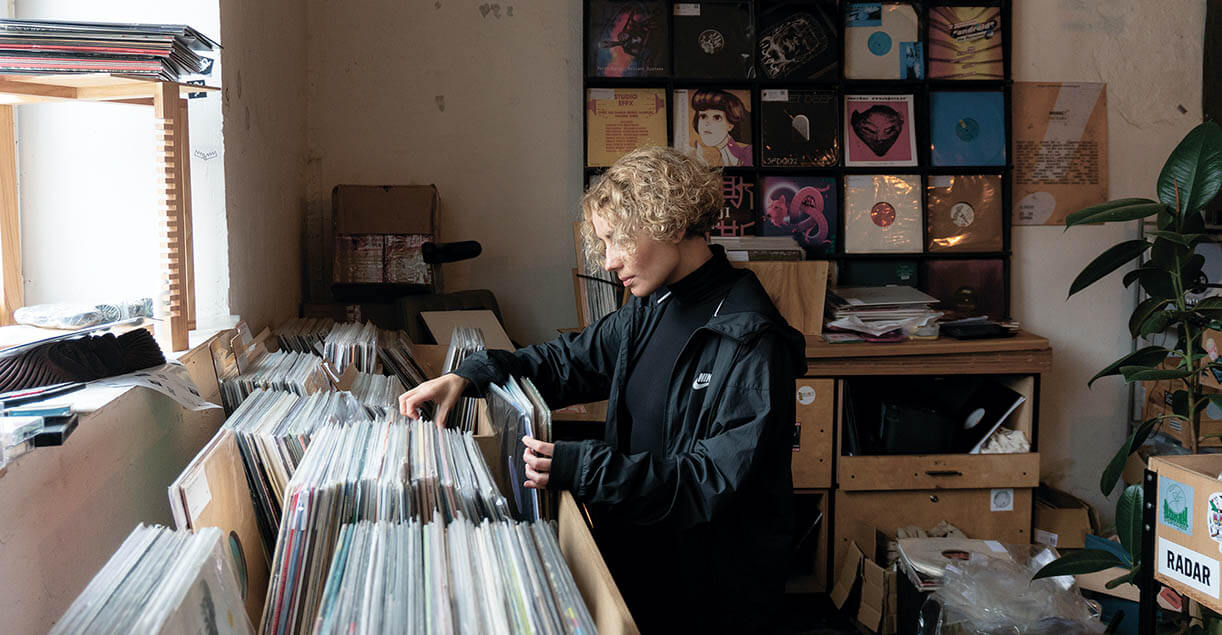
As a producer, selector, Dj and owner of a record label, where does your love for vinyl come from? What are your favourite labels and record stores?
I was a vinyl-only Dj many years ago. Now I can honestly say that I love vinyl at home more than on tour. Nevertheless, I buy records all the time, even during the war. My favourite record store is Closer Record Store. It's run by my friends, my very first record was presented there and they are great guys in general. The list of my favourite labels would certainly be very long. I'd rather highlight one that influenced me and that I am still studying. It's FAX +49-69/450464.
If I'm not mistaken, you also perform Live right?
Yes, Na Nich and I prepared an hour-long live program, which was presented only once at the Natura festival. We have a lot to show and I'm looking forward to performing together more.
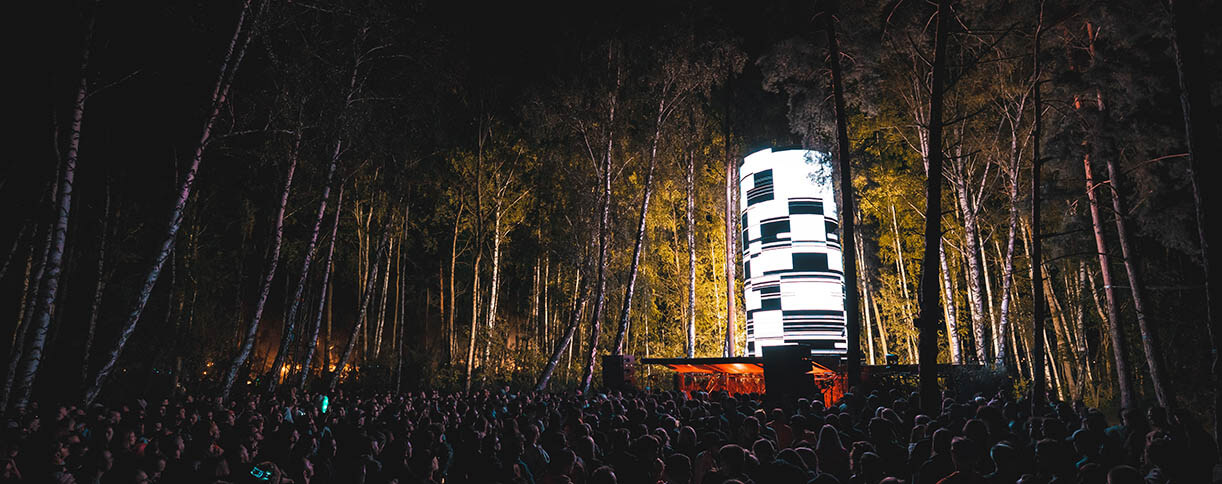
Yes, you organise the Natura Festival as well (see photo above). Could you tell us more about it?
We divide our Rhythm Büro events into indoor events and festivals. Indoor events take place during the cold season, they all are only one night long. As for the festivals - we have a few - Natura Festival and Extra. Natura is a huge summer open air event (we've done five editions already), and Extra Festival (we held just once) - here we combine indoor and outdoor format. The main idea is to give something more than a party, but less than Natura with its camping and remoteness. Since Natura is our most special event, I'll tell you a little bit about it. Natura it’s always about a carefully selected line-up that takes place just once a year. Hypnotic techno, ambient at night, house music during the daytime. The location is located 30 km outside Kyiv. In addition to multiple stages, the biggest part of the venue is given to the really huge camping. You would be amazed at the scale of it. To get the coordinates, you need to buy the tickets beforehand, and we send out GPS coordinates and other important info via both email and sms to all ticket holders one day prior to the festival. It allows us to not only keep the value of the event’s guest list, but to also maintain the main tradition of all Rhythm Büro events: secret locations. Respecting the core tradition, whose origins can be traced to the dawn of Rhythm Büro history, most of the events held by our team are held secret. Natura — is quite a young festival. It first opened its doors in 2017, 2 years after the series of Rhythm Büro events was launched. Yet, it wouldn’t be possible in the first place if not for the preceding 10 years of experience in the industry of our team’s members. Despite all the secrecy, remoteness and almost a complete absence of ads and event’s promotion, Natura gathered over 4000 people for two years in a row. It is just that unique case, when all the guests have their Why and Where straight on coming to the event. With that in mind, all the early-bird tickets always get sold out right during the first hour of the event’s announcement. Unfortunately, in 2022 we put on pause all of our event activity because Russia brutally attacked our peaceful country. We don't give up hope and try in every possible way to support our defenders. For now, the festival has been postponed until 2023, and we don't except the possibility of another postponement. The main thing is that we have no doubt that Ukraine will hold out and fight back the invaders. If Russia gains control of Ukraine it will be a different Europe afterward, and other neighbouring countries will be next. By the way, I'm answering this interview from my Kyiv apartment during an air raid siren and there is a threat of missile strikes. We are no longer afraid of anything. We want the war to end and keep asking the whole world to unite and help us fight this cruel aggression.
Today, you live in Berlin, how do you perceive the spirit of the city?
Actually, I don't live in Berlin. My home is in Kyiv, but while Ukraine is at war, I live between Kyiv and Budapest. Berlin is beautiful, I love this city. It is also a great choice for those who are building their career on connections. I have never been that kind of person, to be honest. So far, I need a quiet studio environment, an airport nearby, proximity to Ukraine and my family around. Considering everything that has happened in our country and with our business, I am not even mentally ready to search an apartment in Berlin with all the circles of bureaucratic hell. I really hope for peace in Ukraine.
How was your first Berghain gig?
I was more than excited to play at Panorama Bar. My experience of combining techno and house music and Dj sets at Closer Club (Ed.:major club in Kyiv) allowed me to open up very confidently. That night was very memorable for sure.
What does music and the electronic scene represent for you today? Any message you would like to convey?
There's a nice saying: love the music in yourself, not yourself in the music.
If you could teleport yourself for a few hours, where would you choose to go?
It is certainly worth going to see Triadic Ballet by Oskar Schlemmer in the '20s, for example.
Finally, who is the “current” Vera Logdanidi in 3 words?
A very optimistic refugee
Interview by Sabrina Bouzidi
Photo 1 by Taras Vorobets
Photo 2 by Polina Polikarpova
Photo 3 by Max Ambio