2025-12-02
SUNK
In China, the electronic scene has been booming very fast the last few years. Hailing from Beijing, SUNK has established herself as one of the most promising and key figures of the movement. Her compositions and live performances fuse the traditional sounds and Oriental legends elements with techno, progressive and break music. Very influenced by the riche Chinese literature, each of her albums is a gateway to her philosophy of life: “Day Chronology” was released in 2020, “The Mountainsea” in 2021 and she’s working on a third album “The Waymaker”. From her studio, the multi-instrumentalist speaks about her references and willingness to share her cultural heritage; her vision of the avant-garde sound, her neo-classical duo “Echolink” and some memories from her Europe Tour last Summer. On the 05th December, she will perform at the Nyokobop festival in Paris.
Welcome, a glass of?
Black tea
Where do you come from?
I didn’t come from an artistic family. From my great-grandparent’s generation onward, almost everyone in my family worked in government or education as principals and teachers. I grew up in a very traditional household, and as a child I was considered the most unconventional one. My siblings were all top students, while I only started studying very hard in my final year of high school out of fear that I wouldn’t get into university. Eventually, I did get admitted to a university. My bachelor’s degree was in Industrial Design, but after graduating, I didn’t pursue design because I found the work too monotonous. At the time, China’s internet industry was booming, and I was fortunate enough to join it, working in major Tech companies such as Baidu and Alibaba, which are considered “big factories” in China. My last job was as a marketing manager at BMW China. I never attended a conservatory or received formal music-school training. I learned music production on my own while working full-time. I performed as a Dj in my spare time and learned production through apps and online tutorials. As for music theory, I took eight private lessons from a teacher in a training class to learn the basics, then continued studying jazz theory through online videos. I play the Dizi, a Chinese bamboo flute, a bit of guitar and synthesizers. For band or solo live performances, I often use an electronic wind instrument.
How did you discover electronic music and who are your main references?
The first electronic music festival I attended in China was Intro, one of the earliest electronic festivals in the country. I was completely swept away by the atmosphere, and that’s how I fell in love with electronic music. There isn’t one specific artist who influenced me the most. My inspiration comes from all the music I encountered growing up. I love the soundtracks of 1990s Hong Kong martial arts films, with masters like Huang Zhan and Hu Weili. I also love post-rock, and when I was younger, I enjoyed new age music. When I discovered electronic music, I felt it was the perfect tool to realize all the musical ideas and inspirations I had.
What was decisive to become a producer?
When I was DJing, I felt it wasn’t enough to only mix other people’s tracks. I wanted to express my own ideas and play my own music. So, I decided to become a producer.
Where is your studio and what kind of gear do you use for production?
My studio is in Beijing. I use classic hardware synthesizers and drum machines such as Moog and Roland, as well as software synths and DAWs. I also record the instruments I play myself, including trumpet, saxophone, Chinese bamboo flute as the dizi and the xiao.
Could you describe your sound in 3 words?
Oriental, Innovative, Electronic.
What is your current live setup and since when do you perform?
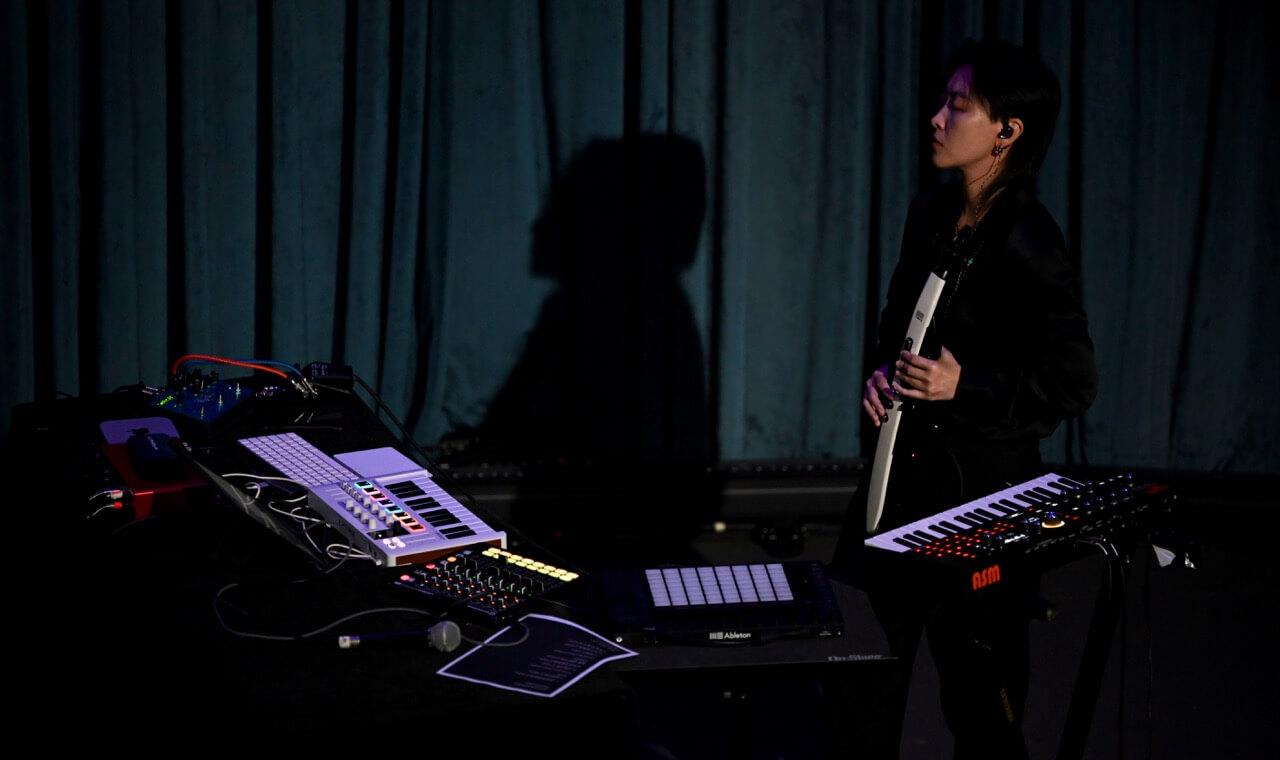
Like most electronic artists, my live setup includes a computer, synthesizers, and an electronic wind instrument. I began doing live shows in 2021 after releasing my first album. That album was also the reason I wanted to perform live; to have full control over my music and to be able to collaborate with other musicians in a live setting.
Speaking of which, what does your first album “Day Chronology” represent?
“Day Chronology” is inspired by the ancient Chinese time-keeping system “Heavenly Stems and Earthly Branches.” You can think of it as an ancient Chinese “coding system,” used to record and sequence time—years, months, days, and hours—similar to how we use letters and numbers today. The Heavenly Stems consist of 10 characters, and the Earthly Branches consist of 12. The 12 Earthly Branches also correspond to the 12 traditional Chinese “shichen,” with each shichen equal to about two modern hours. My album selects four of these shichen—for example, Yin Shi, the transitional time between night and day. This coding system has many functions. The 12 Earthly Branches also correspond to the 12 zodiac animals. Every person is born with a year, month, day, and hour, each matched with a Heavenly Stem and Earthly Branch, forming an 8-character set called the Bazi. This is like a “personal code,” used for compatibility—similar to astrology—to see if two people align well romantically or in business. The system is enormous; I can only explain a tiny part of it here.
What about your second album “The Mountainsea”?
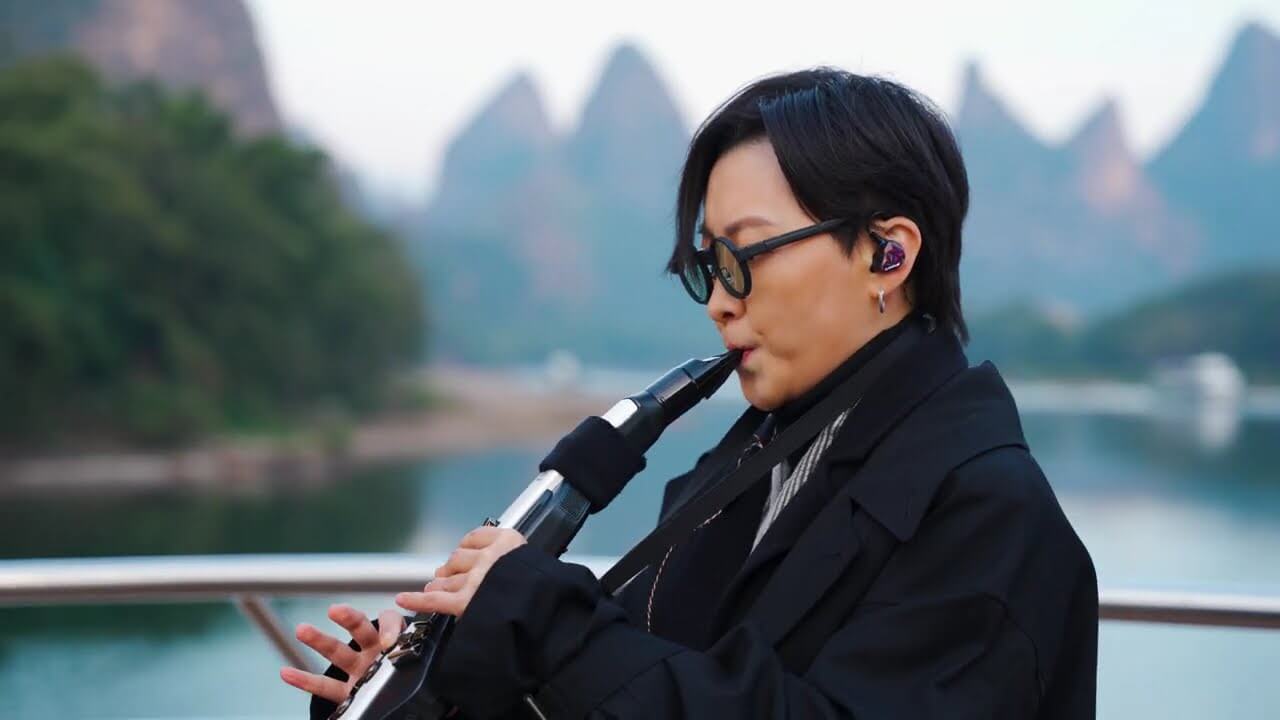
My album “The Mountainsea” has a live version that I performed with ZheLai—the vocalist of the Black Myth: Wukong theme song—and the well-known Chinese producer Kiddou. ZheLai performed vocals and percussion, Kiddou played guitar, vocal synth, and zhongruan, while I performed electronic wind instruments such as the xiao, shakuhachi, dizi; synthesizers, and handled the overall production and engineering. The performance was a huge challenge for me because it was a live broadcast held on a moving yacht on the Lijiang River in Guilin, one of the most beautiful landscapes in China. Performing my Chinese electronic works in that setting felt like the music was finally placed inside its most natural and fitting environment. It was completely different from a club or studio performance. At the end of the show, two flocks of egrets flew across both sides of our boat. I felt as if the mountain spirits and creatures of Guilin had heard our music and were sending us their blessing.
In your recent track “The Waymaker”, who speaks and what does he say?
“The Waymaker” is the name of my upcoming album, not fully released yet. The lead single is Taiji Zhang Sanfeng. In that track, I used two spoken excerpts. One comes from the Taiji philosophy of Zhang Sanfeng, the creator of Taijiquan. Taiji originates from the concept “Wuji gives birth to Taiji”—order emerging from chaos. Taijiquan emphasizes “formless form,” meaning “overcoming moves with non-moves,” responding naturally and fluidly rather than relying on rigid techniques. The second excerpt is from the famous Chinese novelist Jin Yong. In his novel “The Heaven Sword and Dragon Saber”, he portrays Zhang Sanfeng and includes the lines: “Tā qiáng yóu tā qiáng, qīngfēng fú shāngāng. Tā héng rèn tā héng, míngyuè zhào dàjiāng”. This means that no matter how the outside world changes, one must remain mentally unwavering—the highest state of self-cultivation. Both Zhang Sanfeng’s philosophy and Jin Yong’s writing express the same Chinese idea: Do not be disturbed by the outside world; true strength comes from within. Even the softest drop of water can eventually pierce the hardest stone.
In “Taiji Zhangsanfeng”, what is your main inspiration?
I love Chinese culture: architecture, history, martial arts. And this track is inspired by the works of Jin Yong, one of China’s most influential writers.
What does electronic music symbolize?
To me, electronic music is a product of technology. It transcends the limitations of traditional acoustic sound, which relies on air vibration, and creates new sonic worlds through computers and synthesizers. It generates sounds that never existed in nature, making it one of the most imaginative musical forms.
Could you speak about your band Echolink please?
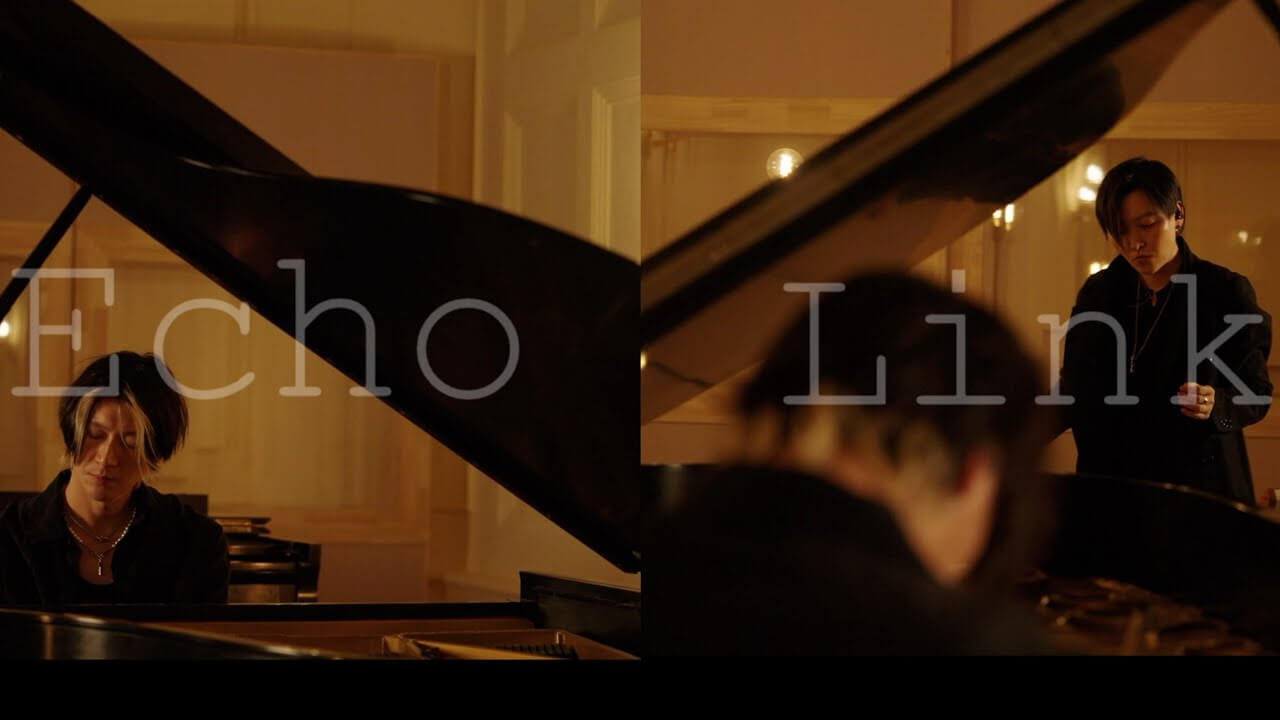
Echolink is a neo-classical electronic duo formed by me and my friend, pianist-composer Xiao Ying. It’s a new experiment for me within electronic music. Sometimes making music alone feels isolating, so collaborating with other musicians brings fresh sparks; it’s something I find truly enjoyable.
What effects are you looking for on the audience?
It depends on the context. At ADE’s Wereldmuseum, where the theme was Made in China, I presented a very representative Chinese Oriental electronic live set. I wanted the audience to hear something uniquely Chinese while still feeling the groove and rhythm. For Dj sets, I prepare depending on the venue and time slot. I adjust my tracklist in real time according to the crowd’s reaction, hoping to create moments of joy, dancing and emotional release.
What is the message you would like to convey through your work?
I hope listeners first remember that I’m an electronic music artist from China. My work incorporates Chinese philosophy, aesthetics, music, art and literature. Through sound design and composition, I build my own Oriental electronic identity. I want people to discover my culture through my music, and eventually become curious about Chinese electronic music and China’s traditional heritage.
Which is the main town of techno in your country?
This is just my personal opinion, but I believe Beijing and Shanghai are the core cities for techno in China. Beijing has a long, diverse music culture - from the earliest electronic festivals to influential clubs - continuously nurturing talent that spreads across the country. Shanghai, being highly commercial and dynamic, offers numerous opportunities for electronic artists to develop and showcase themselves, with strong commercial support.
Which clubs in your country do you like to perform in?
In the past, I performed at Lantern and BEEN in Beijing. Now I often perform at Groundless and Solo in Beijing, Dirty and System in Shanghai, Window and MINOS in Guangzhou, and FLAT in Chengdu… Big Chinese cities all have their own clubs with unique identities; each with its own style. I hope more people can come to China and experience this diversity themselves.
Which Chinese labels should we know?
You can follow Beijing’s BCR and YinYang, Chengdu’s NEED MUSIC, and Shanghai’s SYSTEM. They are some of the newer and more active labels in China in recent years. They produce online radio shows and organize offline events.
Your top 5 record stores in China?
There are actually very few physical record stores in China. I usually buy records online.
Your best live experience?
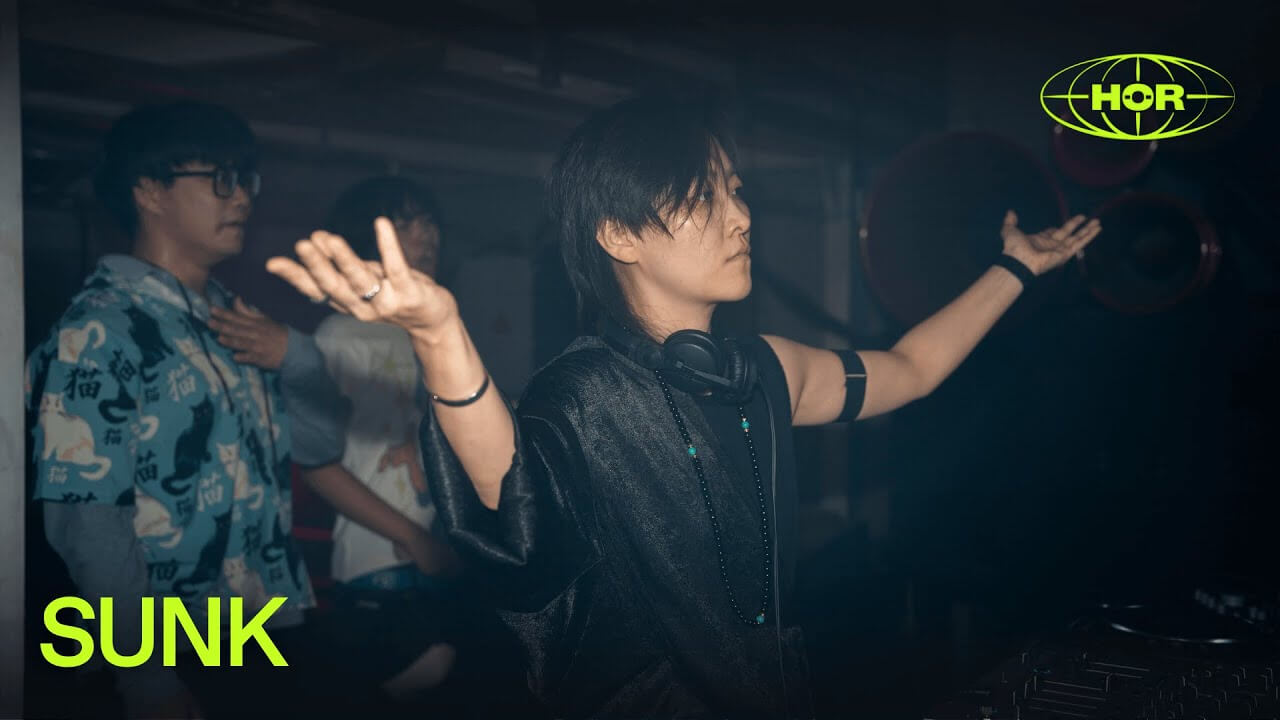
During my European tour this June, my third stop was at Le Sucre in Lyon, France. My slot was 3am–5am. I opened with “Taiji Zhang Sanfeng”, and the whole room exploded. Even though the tour had been exhausting, the audience’s energy ignited me all the way until sunrise. They even shouted “one more!” after my last track. It was my first Dj set in Europe, and now for the Paris NYOKOBOP festival I’ll play from Oct 5th 4am–5:30am. I hope the Paris crowd will cheer for me just as loudly.
曲谐(Zen), by SUNK
幻境(Illusory state), by SUNK
一念宗师The Waymaker, by SUNK
曈曈(The sunrise is bright), by SUNK
花月夜(Night tour water town)., by SUNK
Speaking of which, what is your impression about this European Tour?
It was incredible! It was my first European tour, and aside from the music itself, I handled every part of the tour on my own—from negotiations six months in advance, to contract review, to preparing all the logistics for Europe. I traveled alone with a 25kg suitcase and a 10kg backpack, crossing three countries and four cities in half a month. I experienced heart palpitations, airsickness, getting ill, getting lost, and sleeping only four hours a night on average. Fortunately, at every stop I met friends and strangers who helped me. It wasn’t just a “tour”, it felt like an adventure. Fear, excitement, anxiety, relief, wonder, and surprise—every day brought something unexpected. All I could do was prepare for every possible scenario and keep moving forward. I only truly relaxed when I boarded the plane back to China. On the 11-hour flight, I slept for nine.
Bravo! Would you like to move to live abroad?
I don’t have any plans to move abroad for now, but I might spend part of every year in Europe for performances or short stays. Most of my work is currently based in China, and my friends and family are all here. But who knows what the future will bring—maybe one day my thoughts will change.
What do you think about AI?
I think AI is a great assistant and an irreversible trend. I use AI almost every day to help me with translation, legal wording, research, and general knowledge. In the future, people who know how to use AI well will definitely have a huge advantage over others.
What are 5 of your favorite albums of all time?
. Ryūichi Sakamoto “The Last Emperor” Original Soundtrack
. Huang Zhan "Green Snake” Original Soundtrack
. The Chemical Brothers “No Geography”
. Grandbrothers “All the Unknown”
. Ten Walls “Symphony” (Orchestra Live)
If you could teleport yourself for a few hours…
I’d like to visit my future self, though I’m also afraid of knowing the outcome too early.
Your projects for 2026?
For now, I only plan to release my new album and work on more musical collaborations. I also want to explore more cross-disciplinary projects. This year I composed for film and also performed and gave talks at museums and art institutions. In 2026, I hope to try even more new things. As for touring, nothing is scheduled yet, but I plan to tour Europe again next year.
The current SUNK in 3 words?
Content, calm, free.
Anything else?
Thanks for this interview. I hope more people will come to China in the future to experience Chinese electronic music—and to hear my live performances.
Interviewed by Sabrina Bouzidi / photo by 梁耕 Liang Geng