2026-03-23
MARK ADAMS
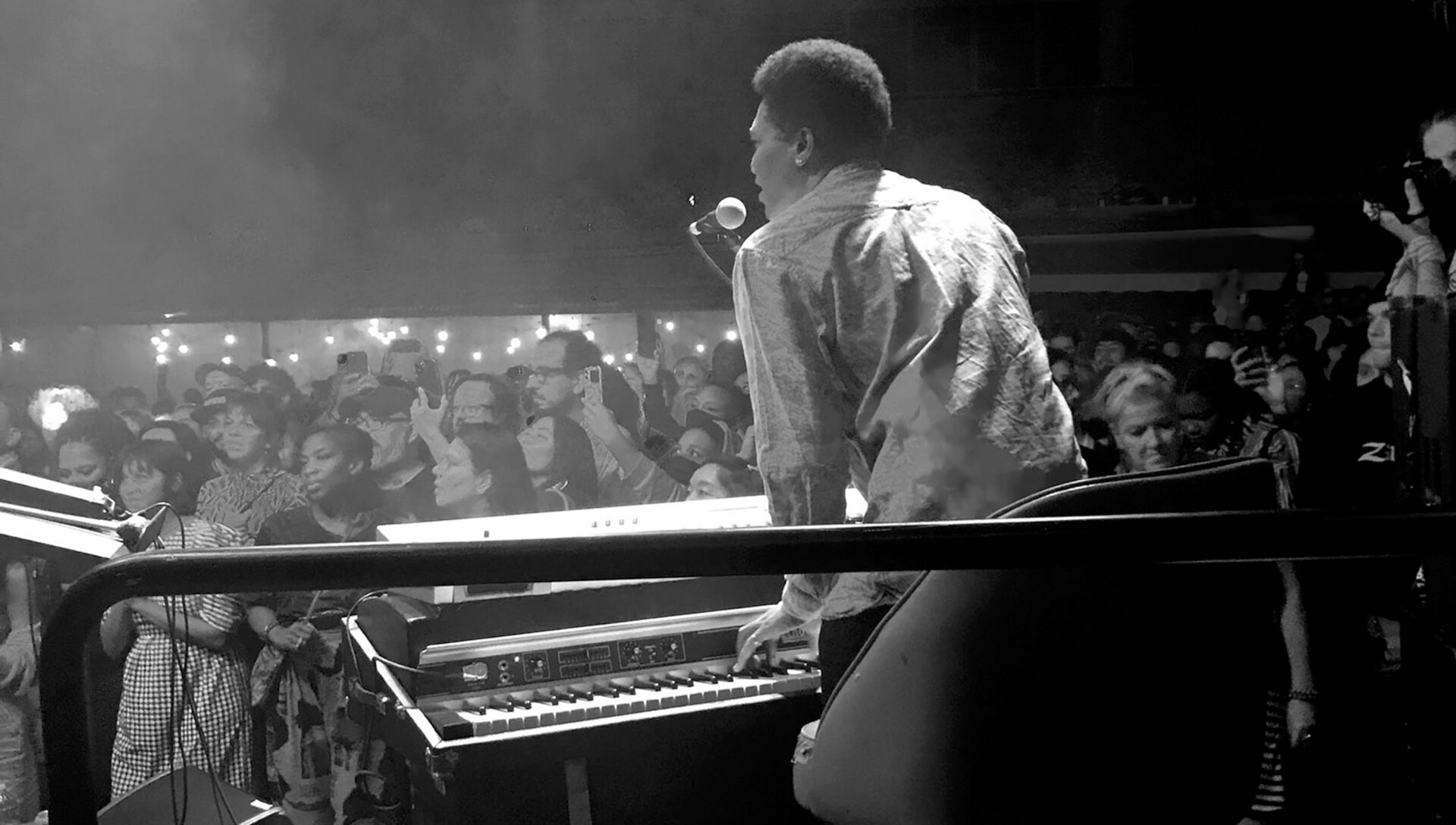
The genesis of this project began in 2012, when David Schwartz, musician and head of Down Jazz Records, witnessed Mark Adams's incredible virtuosity in playing two keyboards simultaneously during concerts for the legendary Roy Ayers. From this encounter in New York, Mark became David's mentor, introducing him to his fellow musicians. This led to recording sessions and the album "This Is Neo-Soul." Meanwhile, in March 2025, Roy Ayers passed away and this album became a posthumous tribute to the legendary vibraphonist. Since then, Mark Adams and David Schwartz have shared their passion for gospel, jazz, funk, hip-hop, and electronic music, aiming to perpetuate the art of improvisation of the Godfather of Neo-Soul. An interview with Mark Adams provides an opportunity to discuss his mentor-student relationship and later his role as Roy Ayers' musical director, shedding light on this new artistic direction.
Welcome, a glass of...
A nice Grenache wine or Pino Grigio.
What was the song you listened to yesterday?
“That’s You” by Lucky Daye
Where and in what environment did you grow up and did you have vinyl records at home? Was the piano your first instrument?
I grew up in Baltimore and my family moved to New York when I turned 12. Yes, piano is my first instrument. My mother played piano and taught me when I was about 7 years old, & my dad was a musician on Broadway. I then started studying with private teachers. I later studied with Mike Longo, Jaki Byard and Kenny Barron during my teenage years. I have a Bachelor’s degree in Music Performance and a Master’s degree in Music Performance, City College, NY and Master’s from Queens College, NY.
From what year did you begin collaborating with Roy Ayers? You must have an unforgettable memory of your first meeting…
I graduated May ‘91 and I was on the road performing with him on July ‘91. Before that, I auditioned at a studio in Manhattan. I was ready to play for Ayers, but the audition never happened because he didn't show up. It was his manager, David Baldwin, James Baldwin's brother, who approved it. Days later, I was on stage at Fort Worth's Caravan of Dreams. I had never played at a jazz venue so large; I was playing with a superstar in his prime and I was just in awe of it. Midway through the set, Ayers stood behind him and barked : “Play the fucking keyboards… you’re playing like you scared of the keyboard. They ain’t gonna bite you”. Ultimately, this first tense encounter marked the beginning of a friendship that lasted for decades.
Great musicians are often very strict… Even today, most jazz celebrities don’t receive the same treatment as pop or rap celebrities. On stage and on tour with Ubiquity, how do you describe him?
Roy was always very positive, his criticism was constructive. Roy would say “Develop your solos”. Listen to “Red Garland”- practice actively soloing, which made me think while playing. Roy Ayers was an amazing musician and an amazing person. Every show was memorable with Roy. We used to play at Ronnie Scott’s in London for 3 weeks, twice a year, 2 shows a night and sold out. It was just an incredible experience. Roy Ayers was so much fun on the road. Roy and I played chess together all the time. Roy received celebrity treatment everywhere he went. Roy was modest and down to earth. Touring with Roy was so much fun. I loved hearing him share stories with me about other musicians and his early years in the business.
Roy Ayers has taught you a lot, did the student surpass the master?
I learned so much about music from Roy. He was a master improviser and he taught me so much about improvising.
How did you become his musical director and what was your role?
I became Roy’s musical director after Zachary Breaux, who was his former musical director, passed away. Roy recommended me to start playing with him as his musical director. My role was to start songs, end songs, and do various arrangements of Roy’s music.
Roy’s latest projects were concept albums like: ”Roy Ayers / Adrian Younge & Ali Shaheed Muhammad – Jazz Is Dead“; & “No Deconstructs The Music Of Roy Ayers… ». Were you with him during these projects?
Yes, I was with Roy in the studio during those projects. A lot of great musicians and we all composed a lot of great music.
What memories do you have of your concerts in France?
Performing at the New Morning jazz club in Paris was super awesome. Also, performing at the Nice Jazz Festival many times was amazing and I got to meet so many bands. Roy first had to break into the European market and then next year, there were lines around the block for our shows. At one Nice Jazz Festival, we played with Eryka Badu which was fantastic and got to hang out over dinners in Nice.
I believe Ayers passed away in the middle of the album production. Is “This is Neo-Soul” a tribute to Roy? (streaming below)
“This is Neo-Soul” is a tribute to Roy. When Roy passed during the production of the album, we were incredibly saddened by his loss but it did not affect the album, because I choose to focus on Roy’s spiritual life as opposed to his physical death. Even though it’s a dance record, it has load of jazz improv, with a 70’s sound.
Sweet Tears, by Mark Adams
"Open Letter", by Mark Adams
Day Dreaming, by Mark Adams
Expansions, by Mark Adams
LLS Groove, by Mark Adams
Don't Stop the Feeling, by Mark Adams
Talking Walls, by Mark Adams
Don't Look Back, by Mark Adams
Vibrations, by Mark Adams
Dre's World, by Mark Adams
How did you decide on the extra musicians for “This is Neo-Soul”?
This was a decision made by David Swartz who produced this album. Different musicians bring different flavors to the music. They are all my friends and I’ve performed with them in different bands over the years. For example, several of the musicians including Bill White, a guitarist, played in my “Soulful night of keys” tour with Lonnie Liston Smith and Brian Jackson. Monte Croft, vibes player, his wife and my late Aunt were best friends. I’ve known him since I was a kid. Monte also plays guitar & every other instrument and is a professor at Berkley School of Music. Chris DeCarmine, our drummer, was a longtime friend with Kimberly Davis, vocalist with Chic. Luckily, she had a break during touring and we were able to do a vocal session.
Were you inspired by your mentor during production of the album? Can you explain what was going through your mind at the beginning of creative process?
I was definitely inspired by Roy Ayers during the production of this album. David Swartz had a vision of a dance record with upbeat dance songs. I loved the idea. I wrote some of the songs and collaborated with David on some songs and also with my drummer Chris DeCarmine. All sessions flowed really well. We even had local Brooklyn gospel singers. Chris Gilroy is a Grammy audio engineer and he helped pull all this material together. One big collaborative project.
The first time I listened to the album, “Vibrations”, “Dre’s World” and “Day Dreaming” particularly resonated with me. I know it’s a difficult question, but what are your three favorite tracks?
I liked my arrangement of “Sweet Tears”, “Talking Walls”, and “Open Letter”.
Can you explain what makes "This is Neo-Soul" innovative and is it necessary for you to innovate when you compose?
Composing is innovating. Roy Ayers always told me. As a young black musician, you have to continue to innovate. Keep coming up with new ideas. It was a new concept for me. I had never done a dance record before, or a record where there was only one instrumental track, yet there are loads of improvisation on every song.
Roy Ayers has been sampled over 800 times; his music is very present in hip-hop culture. How does hip-hop inspire your music?
I really love hip-hop, but I wouldn’t say that I am inspired by hip-hop, because I don’t rap. Our new album is being sampled by many creative DJs. I’m sure the hip-hop community will love it.
Exactly! Have you heard the remixes? Were the DJs given complete creative freedom?
I'm sure the DJ community is going to love the remixes. It’s all new for me, and I am enjoying the process. David from Down Jazz who is releasing "This is Neo-Soul", did all the work with the DJs as he has that experience. They were given great creative freedom and I love how the dance tracks turned out. I look forward to them. I think it’s going to be amazing. It’s all about creativity. There are DJs from all over the world including Jimpster, Kaidi Tatham, Crackazat from Sweden, DJ Spinna, EVM128, Bruk Roger from England, Makez from Amsterdam, Kai Alice from Atlanta, Ralph Sessions from Barcelona and many more.
Do you plan to promote this album live?
Yes, we are booking more performances all over the states and Europe. Our new tour this summer is called " Don't Look Back". This is not a tribute band. This is the band. The true representatives.
If you had to choose between a keytar or a piano, which would you choose and what brand?
I would choose the piano. A keytar is supplementary. Deep in my ten years with Roy, I played the keytar. We did a show with George Duke in CA, and he played the keytar. He called it “Dukey’s Stick”. Next time I saw George, I had a keytar with me. Roland is my current brand.
What are the differences between the hands while playing piano and which hand you prefer?
To play piano, you have to be able to play with both hands equally.
You’re also an educator, and you recently published a book. How is it possible to learn to play the piano in a day?
I wrote 3 music books. My latest piano method book teaches a student to read music, learn the notes on the piano and hand position. These can be learned in one day. One will not play like me in one day, but can learn the fundamentals of how to play in one day.
What are your top 3 venues for listening to and discovering the new jazz scene in NYC in 2026?
Café Wha, Groove, or Village Underground.
Please name three recent jazz albums that should not be missed.
Listen to the young singer Samara Joy. “Orbits” by Circling Sun, a group from New Zealand, and the complete live recording of John Coltrane in Paris in 1965.
Finally, what is your motto/adage or your guiding principle?
“We are not defined by our circumstances, and there are no limitation as to what we can do out here as long as we don’t set any for ourselves or allow others to set any for us, and as we understand our own true reality and work from there knowing that God is the source of our supply and all of our needs are constantly being met because there is a divine surplus”.
Interviewed by invisibl journalist / Photo (c)