2025-11-24
LA HERIDA
La Herida is one identity formed by Lorenzo Setti and Eugenio Petrarca. The Italian duo recently released “Dead In Devil's Paradise”, its first album available in limited edition on CD by Arsenic Solaris and digitally by ATME Records. These 11 compositions plunge listeners into La Herida’s experimental world and a trance across acoustic sound and sonic textures. From their studio in Berlin, the producers speak about their main inspirations, the place of the field recording in their work and their vision of concrete music amongst others.
Could you describe your sound?
Abrasive, Spasmodic, Visceral.
How long did you need to produce your album “Dead In Devil's Paradise”?
It was a long journey that began with some ideas for the set-up, which worked for some tracks, but then circumstances forced us to downsize our workspace and take a different approach to composition. We had a lot to say and many ways to say it. It wasn't easy to filter and compose a constellation that encompassed all these phases. For about two years, without ever stopping, sometimes crawling on all fours in the mud, other times carefully measuring each step as if walking on quicksand, “Dead in Devil’s Paradise” came to life.
Your main inspirations?
The forgotten, the anathema of the past that returns, the endless cycles and the marks burned into the skin, the knives and the low-ceiling basements, the difficulty of life in contemporary society, the inadequacy, the impossibility of breathing polluted air, the gray of concrete and the smell of damp, the post-folk of the binary digital era, the drone, experimental, and improv scene, the noise that is in each of our minds, the ancestral call of drums, the sound pressure that awakens you from your torpor, the post club moment, the pulsations that make you vibrate as you descend underground and stop right before opening that door in front of you.
What kind of materials did you use?
Everyday life objects were used on the drums. Sub frequencies were freezed and played out on massive amplifiers. The crudity of analog circuits as well as all the extracted minerals of exploited lands needed to produce a computer logic board were used on this album. Field recordings from Greek Islands as well as from Berlin's streets blurred the confines of this album. Programmed flutes and heavily post produced vocals bled with aggressive sound design and granulators.
What part does the field recording take in your work?
The field recordings are few but very significant. Through them an act of contextualisation and decontextualisation was played. The aim was to create depth and width, to merge scenarios, bounding realities that can also be very distant in space and time to one another and to layer debris as it is for the soil we step on every day.
In the last track “La Curandera”, what does the singer say?
The truth.
Mark Of Arana, by La Herida
Mocoa, by La Herida
Dance Slave Dance, by La Herida
Carved from the Trees, by La Herida
Liquefied Gum, by La Herida
Call The Tapper, by La Herida
The Hollow Path, by La Herida
The Slammer, by La Herida
Desafiante de la Muerte, by La Herida
Havea, by La Herida
La Curandera, by La Herida
What effects are you looking to have on the listener?
This album is undoubtedly the result of a complex and intense period of social tensions in contemporary society. Moments of brutal (sonic) violence and walls of sound, alternated with moments of great sweetness and, in some ways, romanticism are there to impact the emotions of the listeners to disturb and maybe also disrupt them, but also to reconnect them with the present, to take them hand in hand far away on a journey that nobody knows where it leads.
Do your productions reflect the need to refocus on what is essential and escape the frenzy of our society? Is there any political sense?
Politics today often appears as a matter of shifting perspectives, a relative discourse shaped by how it is presented to us. Our intention was to construct a continuous, wave-like movement between tension and release. If this oscillation of sensations and recollections can spark questions or invite reflection, then in that very act, it becomes political.
What role did your collaborators play in shaping the album?
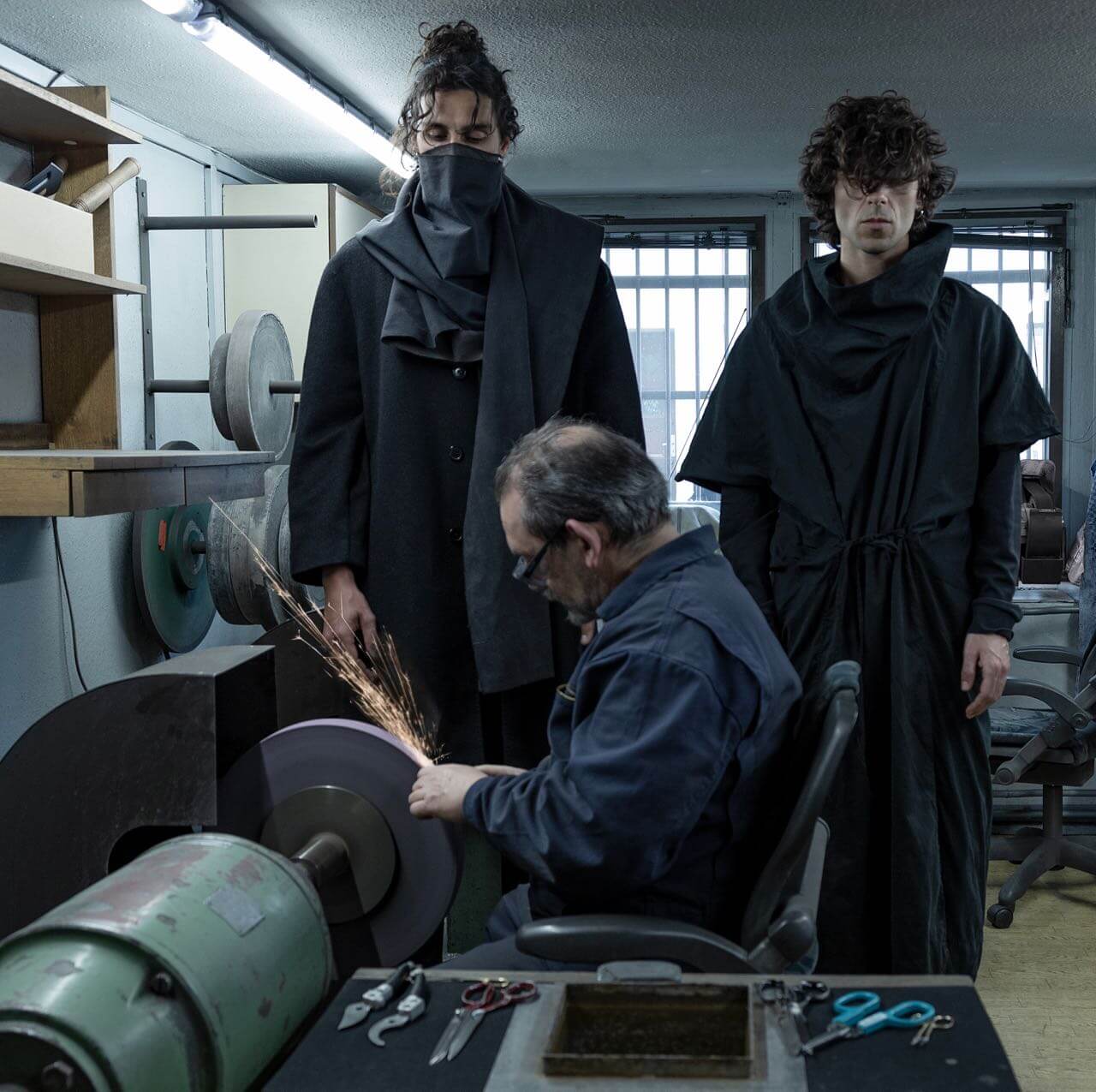
La Herida, in its most fluid form, is made up of many ideas, numerous perspectives, and many people who, through their voices and their practice, have shaped this project. Knife sharpeners, photographers, hand-clappers, enchanted voices, astral flutes, and places of worship in which to record and listen. These arts and crafts merged together to give life to this first work.
Your definition of concrete music?
In the academic sense, it’s a collection of natural sounds reorganized according to an unconventional order that shuffles the cards, giving a different meaning to what seemed to be framed within a certain aesthetic. In some ways, this technique, which originated in France, has influenced many contemporary composers who can be grouped under the broad concept of “electronic music.” Certainly, that step was so important that references to that competitive style and those techniques are present in much of contemporary experimental music. Including this album.
How have you been approached by the labels Arsenic Solaris and ATME Records?
The esoteric and occult aesthetic of Arsenic Solaris label seemed to be in perfect resonance with the album. AS took on the task of handcrafting this album in 150 LTD CDs, and for that we are grateful! The lichen label ATME Records served as a disseminator of seeds in the digital wind, spreading the album to reach the listeners worldwide, but avoiding exploitative platforms.
What does the cover represent?
It represents the fragility and vulnerabilities, as well as the strength and resilience of the album. A dream-like scenario that is at the same time carved in our ancestral memories and coming from what we experience with our very eyes in that exact moment.
La Herida in 3 words?
“Que no cierra”.
If you could teleport yourself for a few hours…
In the jungle, barefoot, sweating and breathing water, while distant echoes gradually draw nearer.
Interviewed by Sabrina Bouzidi / Photo by Martina Della Valle