2025-04-23
JACQUES x GREGORY
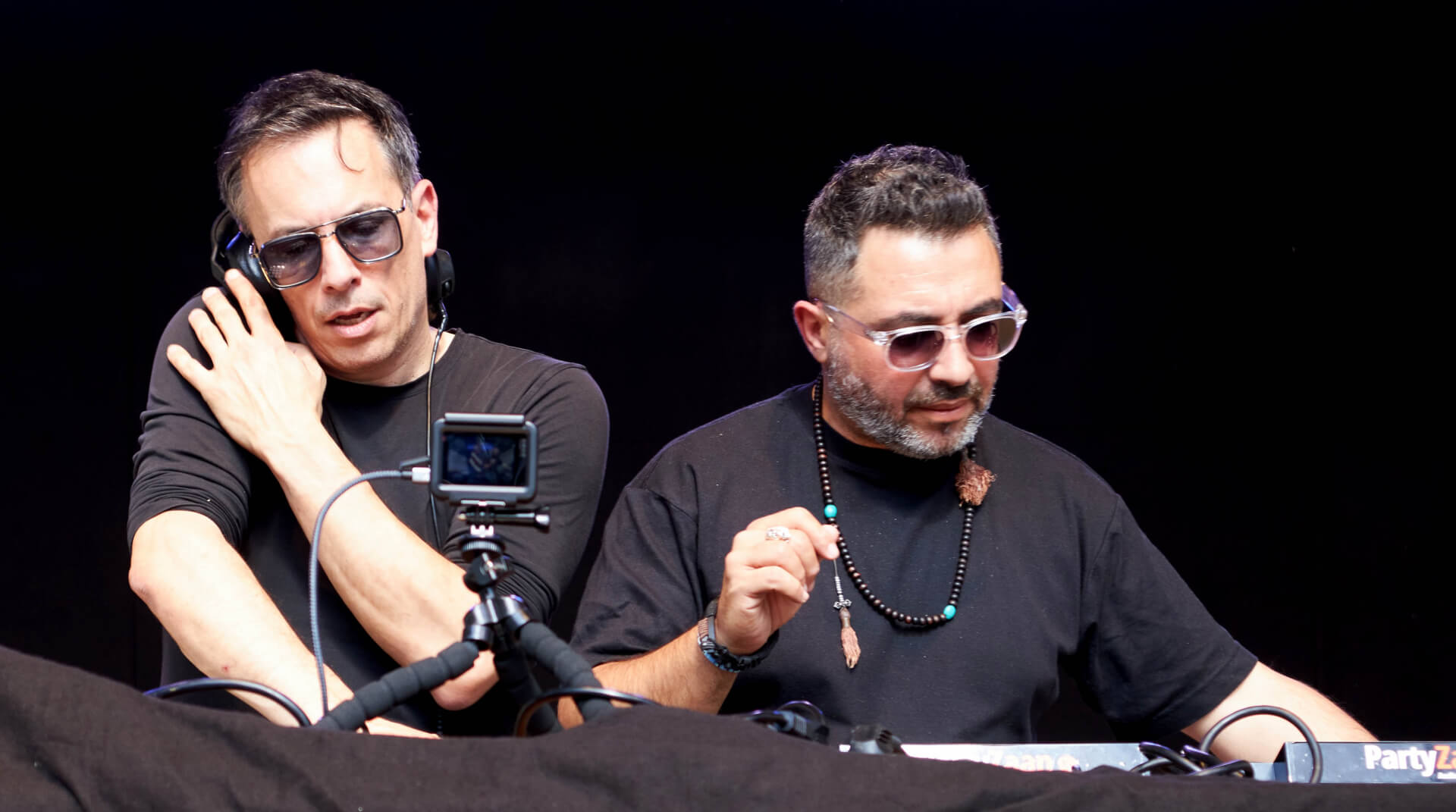
JACQUES x GREGORY is an electronic music duo formed by Jacques Lavoisier, a neuroscientist, and Greg Lion, an outstanding pianist. They met each other in 2012 to collaborate on a show that went on to win the Contemporary Art Biennale in Ancona, Italy. Since then, they’ve toured clubs and festivals around the world and launched their own publishing company. In 2023, they became the first French duo to sign with TRAX Records, joining the label’s roaster of house music legends. Last year, their track “I’ll Take You There” opened “DISCO 3000”, the latest album released by Screamin’ Rachael, the label’s iconic owner (interview here). On April 25, they’ll be featured on Rising Again (TRX 2620), a limited edition vinyl release commemorating 40 years of house music, featuring the original version of “I’ll Take You There” and the previously unreleased “The Ultimate House Party”. As part of their DJs4good initiative, founded to support high-impact social projects, all profits from this vinyl will go to SocialWorks, a Chicago-based charity launched by Chance The Rapper. In this interview, Jacques and Greg share their artistic journey, what they feel about working with Screamin’ Rachael, how their executive producer Pi Rho changed their artistic careers, and their perspective on the house music scene and the industry as a whole. A conversation with two engaged artists at the headquarters of Cave Carli Radio.
Do you come from a family of artists, and did you receive musical training?
G: There are many artists in my family. Yet, the person who had the biggest influence on me is, without a doubt, my father — an incredibly skilled and hard working guitar player, equally brilliant at blues, rock, or reggae. Thanks to him, I was immersed in a very diverse musical environment from a very young age. I’m often told that, as a baby, I wouldn’t stop crying unless I was fed in the rehearsal studio!
J: No artists in my family, unlike in Greg’s. My grandfather, whom I adored, didn’t like music at all. Can you imagine? He’s the only person I’ve ever met who wouldn’t have a favorite song. I find it fascinating that someone wouldn’t enjoy music.
G: My parents quickly noticed my passion for music and made a lot of sacrifices to provide me with the best musical education. They spent hours listening to me playing and, of course, helped me practice, again and again. Over time, my Mom — who had never learned music theory — ended up being able to read sheet music quite well. Seeing my parents and my grandmother believe in me unconditionally was the best thing that has ever happened to me. It pushed me to always aim higher and to improve.
J: It’s funny you should mention your grandmother — mine was the person who took me to the opera for the first time. I’ll never thank her enough for that gift. My parents had incredibly varied musical tastes. There was always music at home and in the car. I grew up listening to Brassens, disco, The Beatles, Joan Manuel Serrat, Brahms, and even Italo disco. My uncle, a biker and a drummer, was – and still is a massive fan of the Rolling Stones. I enrolled in the conservatory, but got bored quickly. I preferred hijacking my parents’ stereo to plug in my Casio VL-Tone. Whereas you, Greg, always said the conservatory was your second home.
G: It wasn’t just my second home — it was my safe place. At the conservatory in Marseille, and later in Nice, I was really fortunate to learn from extraordinary musicians and teachers. Each one helped shape not only the musician I am today, but also the person I’ve become.
J: He’s leaving out the part where he got into the École Normale de Musique in Paris [something like the French equivalent to the Julliard School in New York]. Yeah, minor detail! Then he met me — and that’s when things started to go downhill!
G: I learned much more than music theory from my teachers and mentors: they taught me valuable life lessons, a strong work ethic and, above all, humility. And yes, working with Jacques taught me resilience. I don’t know why and how he does it — he never takes a break. It can be exhausting.
Who are your main musical influences?
J: Aside from Greg Lion? I’m an absolute Bach fanatic. His cello suites — pure emotion. You listen to these masterpieces, and you realize that perfection does exist. Closer to our time, I love Leonard Bernstein for his passion, his knowledge and way of speaking about music, his conducting, and his compositions. And he had such a captivating voice. Speaking of voices, artistry and raw emotion, my favorite musician is Nina Simone.
G: I’m truly passionate about music. I love musical versatility, and every time I discover something new, I rush to the studio to try and recreate it. Understanding a writing mechanism, a sound treatment, or a unique approach fascinates me. The why — but especially the how — obsesses me. So, my influences are constantly evolving, because music is an endless source of inspiration and learning.
J: That’s true. He lives and breathes music. Talk to him about anything and it always ends up being about music and some new technique. I’m as close-minded in my tastes as Greg is curious and open to new things.
G: I love the great classical masters: Bach, Beethoven, Chopin, Shostakovich, Rachmaninoff. Then I discovered composers like Stravinsky, Philip Glass, Varèse, Pierre Henry — and I have to mention Herbie Hancock and the great Quincy Jones.
J: Quincy! The Q could do literally everything, and most of the time, he could do it better than anyone. A key album for me is the one where Georges Brassens plays with jazz legends. It seemed like a strange combo on paper but turned out to be incredibly musical and groovy. That album, one of my dad’s favorites, taught me early that mixing genres isn’t just possible — it can be magical. Technically, I’d say my influences are Ray Manzarek, The Doors’ keyboard player, and Stewart Copeland, drummer for The Police. But if you hear me play these instruments, you’d think their influence got long lost along the way. I also love Jerry Goldsmith — especially his soundtracks for the first two Planet of the Apes movies from the 1960s. So creative!
What about electronic music?
G: In terms of electronic music, there are the pioneers of Chicago house — Marshall Jefferson, K-Alexi Shelby, Joe Smooth, Ron Hardy — and the legends of Detroit: Kevin Saunderson, Derrick May, Juan Atkins, Moodymann. I was also influenced by minimal, techno, abstract, and dub scenes — artists like Ricardo Villalobos, Steve O’Sullivan, Fred P, Boards of Canada, and Drexciya. The list is endless.
J: For me, it all started with Jean-Michel Jarre. I bought the 7-inch of Magnetic Fields — which happens to be the very first record I ever purchased with my pocket money. I bought it because of the hypnotic cover — I had no idea what the music would sound like. If we’re talking dancefloor music however, Cerrone completely redefined how tracks were built for clubs — orchestral arrangements mixed with electronic sounds, long percussion breaks. Also, “Just Blue” by Space, with tracks like “My Love is Music” and “Save Your Love for Me”. The arpeggio on the latter gets me every time.
G: Jacques definitely has a few obsessions — that arpeggio is definitely one of them. Also, Daft Punk’s filter game in “Musique”, the “Long Train Runnin’” guitar riff, Verdi’s “Nessun Dorma” instrumental reprise after the aria, — all musical bits he can’t stop referring to. How did I forget the sequence of Jarre’s “Equinoxe Part 7”. Jean-Michel, please take Jacques for a while, I need a break!
J: Since we’re at it: Didier Marouani, if you don’t know what to do with those “Save Your Love for Me” stems, we’d be happy to give them the JxG treatment …
G: Jacques has musical references he always returns to when writing. He loves Chic and Earth, Wind & Fire, and never stops raving about the Chic remixes by Dimitri from Paris.
J: Dimitri must have had so much fun with Chic’s stems. His remixes are a true tribute to Nile Rodgers and Bernard Edwards’ art — they really bring out the richness and groove. Chic blows my mind every time. I just bought the double vinyl version of the “Diana” album remixed by the Chic Organization. A masterclass in composition and arrangement.
Any favorite albums?
G: So many LPs acted as emotional triggers to me as I learned to truly listen and appreciate music. If we talk about electronic music, everything produced by Boards of Canada, Moritz von Oswald or Kraftwerk has both deeply moved and influenced me. Also “Alcachofa” by Villalobos was a true shock: the essence of raw groove. Regarding house music, it’s mostly EPs that have been with me for so many years. Mentioning only one of them would be disrespectful to the many, many, many others that I adore.
J: For me, Équinoxe by Jean-Michel Jarre is the perfect album. It has everything I love: synths, textures, melodies, harmonies, melancholy, sound design, polyrhythms, and an organic groove. It’s the album I’ve listened to the most. Right after there is Zoolook, which I’d put in the same category as My Life in the Bush of Ghosts by Brian Eno and David Byrne, or Passion by Peter Gabriel. Albums packed with wild sonic, music diversity and inventiveness that left a huge mark on me. I tried to dissect both their old-school and revolutionary production techniques. And then there’s Depeche Mode — my favorite band. “Songs of Faith and Devotion”, I’m so thankful for that album to exist. Blues and rock perfectly blended with samples and electronic textures. Add Martin L. Gore’s songwriting at its peak, plus Flood and Alan Wilder’s organic production — it’s such an exceptional album. “Condemnation” is one of my all-time favorite songs, right next to Lennon’s “Instant Karma” and Nina Simone’s “Please read me”. All share voices that sing notes and scream pain and melancholy.
How did you meet each other and decide to work together?
G: It goes back to 2012. I was composing a ballet for the Contemporary Art Biennale of Ancona in Italy. I had brought some of my synths to the first rehearsal with the dancers because everything had to be performed live. The choreographer brought in Jacques. I didn’t really know why.
J: I showed up thinking I was needed as a composer. But actually, it was my neuroscientific expertise that the choreographer wanted. Let’s just say I wasn’t thrilled to find someone already set up with a bunch of synths. That someone was Greg. But then he started playing, and I loved the music. Like it or not, when the guy on keys has a first prize from the conservatory, you can hear it. You can feel it. And then there was that smile he had while playing — a smile he still gets every time he makes music.
G: Jacques stayed in his neuroscience lane for most of the project — he’s like that, he never steps on anyone’s toes unless he’s sure he can bring value. Thanks to his algorithms, we were able to use the dancers’ brainwaves to generate real-time visuals during the performance. Then he came to me and said he could control synths with brainwaves. Imagine my face when he gave me a demo! Ever since, every one of our productions includes at least one sound texture generated from brainwaves.
J: The project won first prize at the Ancona Biennale. When we got back from Italy, Greg came over to my place and saw all the vintage synths and drum machines in my studio. He told me he expected test tubes and lab benches — not cool music gear. But what we really bonded over from the get go wasn’t just the music, it was how instantly we clicked. We’re like big kids together. I had no idea we’d still be making music together more than a decade later — let alone releasing a vinyl record on TRAX Records. But I did know I’d found a real friend.
Speaking of TRAX Records, what does the label mean to you?
J: It’s the ultimate reference in house music. Rolling Stone magazine once called it the most important label in house music history — and I think that’s a well-deserved title. TRAX means that iconic red label and white logo you see on so many records we used to play. That we still play, actually.
G: When we signed in 2023, the label published an article on its website saying we were the first French duo ever to sign with TRAX. Saying we were proud is an understatement. The article right below ours was about Kanye West using a TRAX sample without clearing it. Wild! That definitely added some pressure.
J: The pressure has not gone away — we’re talking about the legacy of Chicago house music! Frankie Knuckles, Marshall Jefferson, Larry Levan, Larry Sherman, Mr. Fingers, Phuture, Jamie Principle… and of course, Screamin’ Rachael, who’s become a friend — just like Joe Smooth.
G: We love Rachael — she’s brilliantly offbeat and totally unique, just the way we like it. And she’s been so kind and generous with us from day one.
Your definition of house music?
J: Give me a TR-909 and a piano, I’ll play “Raw” by K!nk and you won’t be able to stop yourself from dancing with a smile. That’s house music! A kick drum, an open hat, the right set of piano chords and, before you know it, the dancefloor’s on fire.
G: House music is life. It reflects every emotion — joy, melancholy, energy. House is a transformative journey, an emotional trip to your inner self. You lay down a beat with a TR drum machine, bring in some Roland synths for that acid bite — like biting into a lemon — and soften it with a Rhodes or Wurlitzer for warmth. But above all, house music is about the soul. Every note, every vibration has to resonate with your truest self.
J: On the “Acid” bit, we don’t agree. At all. I can’t stand the sound of the TB-303. I’d rather have a good bassline on a real bass guitar or a Moog.
What’s the iconic house track from the early days for you?
J: “French Kiss” by Lil’ Louis. It may not be the start of house per se, but it was definitely my awakening. These hypnotic loops, the beat slowing down, the buildup… and that moan — what a climax!
G: Hard to choose just one, but “On & On” by Jesse Saunders is often cited as the first house track. Its hypnotic beat and repetitive bassline were groundbreaking at the time. My first real house memories are “Promised Land” by Joe Smooth and “Good Life” by Inner City. These tunes were about freedom, hope, with an incredible energy. That’s what house music is about: connecting people, building a community. House isn’t just music — it’s a movement, one that still impacts me deeply.
J: When I was a teen, I had the 12-inch of “Move Your Body” by Marshall Jefferson — the one released by TRAX Records. A friend who had moved to the U.S. sent it to me for my birthday. That record was a treasure. Sadly, it got stolen during one of my sets. Before that I played it again and again. If someone had told me back then that I’d one day release a record on that label — I’d have never believed it.
I'll Take you There
The Ultimate House Party
Greg, I heard you had your own label before?
G: My partner and I have a multimedia production company focused on podcasts and events. I’ve had several projects in the past, and the idea of creating my own label was always in the back of my mind. But back then, nothing really happened. It was more like a teenage dream. That said, as you grow up, sometimes you get the chance to realize those dreams. And what better way to do that than with another big kid? Jacques and I are launching our music publishing company –Maison Jacques x Gregory– and a label is definitely on the way. We already have some exciting projects in development.
What’s the story behind “I’ll Take You There”?
J: It started with a request from our friend Pi Rho — a genius producer from Chicago, super eclectic, the kind of guy who’s successful across various sectors: business, arts, sports. Everything he touches turns into gold. He had started working with TRAX Records and asked us to remix “Rising”, a song by Screamin’ Rachael and DJ ThädX, a young producer from Nashville.
G: That’s really where everything began between TRAX Records and us. But as we worked on what was supposed to be a remix, we ended up keeping nothing — not a single sample or sound from the original track. And the vocals — which are amazing — didn’t work with the music we had produced.
J: That bugged us a lot because we really wanted to collaborate with Rachael — the queen of house music. So we wrote new lyrics about what happens when you dance — in a club, on the street, at home — wherever. Dance transports us to a state of well-being that only music can offer. Our bodies and minds are elevated. That’s what “I’ll Take You There” is about. We wanted to take people somewhere else with that track.
G: Rachael immediately connected with the lyrics, added her personal touch, and kindly recorded vocals with her unique signature sound. Once we had her topline, we spent a lot of time finding the right effects and harmonies — keeping it ethereal without losing the raw, raspy quality that defines her voice.
How did that track end up opening Screamin’ Rachael’s new album DISCO 3000?
G: Rachael told us that the first time she heard “I’ll Take You There”, she instantly knew it would be the opening track of her new album. That was a huge honor for us — especially since the feedback on the song has been overwhelmingly positive. Here’s a scoop for you: a new version of “I’ll Take You There” will be released later this year as part of the celebrations for TRAX Records’ 40th anniversary.
How did you produce the track?
G: The sick bass sound comes from an ARP Odyssey that I played live, tweaking the filters in real time — no automation, no quantization. We wanted an organic groove to contrast the mechanical side of the beat. Most of the drums and percussion were programmed into our Digitakt. We did the bulk of the production in Pro Tools — our go-to DAW for finalizing tracks, mixing, and mastering.
J: We used brainwaves to create one sound and to filter two others that made it into the final version. Besides that, we really wrestled with the arrangement — it was way too complicated at first. We stripped it way down. And that was definitely the right call.
A banger In three words?
J: One. Phat. Bassline.
G: Groove. Goosebumps. Energy.
You guys founded Cave Carli Radio. Any stories you can share?
J: When Marshall Jefferson came by, that was a huge moment for us. Right after his interview, the DJ who was scheduled to follow up didn’t recognize him. He started a house music set without realizing he was playing in front of a legend. Marshall, being the generous soul he is, stayed, cheered the DJ on. A true lesson in humility and kindness — just like what he represents in house music history.
G: We’ve got so many stories after ten years of this amazing project. But first — the name. Cave Carli Radio. Our very first studio was literally a basement converted into a studio, located right across from the Marseille Conservatory of Music, also known as the Palace of Arts or Carli Palace.
J: Because of me, you went from Carli Palace to Cave Carli. That’s quite a downgrade!
G: I wouldn’t change the name Cave Carli for anything. It perfectly captures the spirit of the project: a humble base, full of ambition and creativity. As for the logo (a stylized horse head), it’s a nod to the bronze statue Cavallo, San Marco II by Ludovico de Luigi, located on the pétanque court next to the Carli Palace. It became part of our visual identity.
J: In over 10 years, the station has attracted millions of listeners around the world. We’ve got followers in more than 100 countries.
G: We’re so grateful to all our residents, some of whom have been with us since the very beginning. We’ve built an international community of passionate people sharing their artistic voices over the airwaves. I’m proud that we’ve created that.
J: But Cave Carli Radio isn’t just about music and art. It’s also a platform for education and social impact, working locally here in Provence-Alpes-Côte d’Azur and developing international partnerships. That’s why we founded DJs4good in 2016 — to connect people globally and have a stronger positive impact.
G: Our mission is to promote access to culture for underserved people — especially kids whose families can’t afford extracurricular activities. From the beginning, Lucile Reboul has led our social impact work. She does an incredible job. That’s always been central to what we do.
We have to talk about artificial intelligence.
G: I’ll let the neuroscientist handle this one — it’s his thing. I’m going to take a quick nap because once he starts, you’re in for two hours. Catch you later…
J: We’ve developed our own AI systems that can transform brainwaves directly into sound, or into CV gate signals to control vintage synths, or MIDI signals to control plugins. We use sensors that monitor the brain’s electrical activity in real time. These are called brain-computer interfaces. When we use this technology live, we call it The Neuromix. The very first one dates back to 2012 — we already mentioned the show in Ancona, Italy. But since then, we’ve performed Neuromixes in Puerto Vallarta (Mexico), the Mori Museum in Tokyo, the MUCEM in Marseille, the Rubin Museum in New York, the Great Wall of China, and the Media City amphitheater in Dubai — in front of more than 15,000 people.
G: Okay, you can stop now. Next question, please (laughs).
J: Wait, one more thing. AI also helps us meet artists who do more than just music. At the Grand Palais in Paris, during the AI Action Summit held earlier this year, we met Agoria, whose music we both love. He did a killer set in the main hall and presented a beautiful artwork with Yohan Lescure. We all met again at the closing gala of EU AI Week in Belgium, where we had the chance to really connect. AI can also create very human connections.
How was ADE 2024?
J: We had already played in Amsterdam in the summer of 2024, thanks to the Alliance Française — huge thanks to them. It was an amazing outdoor set in Vondelpark, the city’s largest park. That helped create a buzz when our ADE performances were announced.
G: We’d both done ADE before — but separately. 2024 was our first time playing it together. And a big part of the TRAX family was there: Screamin’ Rachael, our executive producer Pi Rho, Zewmob from Nashville, and Cartoon and Tennan from Tokyo. We were supposed to see our friend Joe Smooth, who’s working on tracks with us, but sadly he had to cancel.
J: We soaked up tons of music from other artists — especially Jeff Mills’ live show Tomorrow Comes the Harvest at Paradiso with two insane musicians, Jean-Phi Dary and Prabhu Edouard. Just incredible. We also hung out a lot with Rachael and Zewmob — he’s an amazing DJ/producer and the kindest guy. We love them both.
G: We rarely get time to actually hang out with other artists. Usually, we’re just bumping into each other in airports or backstage at festivals. This time, we shared music, meals, hours of conversation and dancing. We geeked out on gear and traded production tips. The vibe was amazing.
J: ADE 2024 reminded me of playing the Winter Music Conference in Miami back in the early 2000s. That same buzz you get from a slightly dysfunctional family reunion.
G: We started with a warm-up private party set, but the main event was our set at probably the most eccentric — and most exclusive — event of the week in Amsterdam: a golf tournament! A wild combo of music, golf, and fashion, sponsored by Porsche, Adidas, and Samsung. DJs were playing on the greens, and we had the honor of performing in the clubhouse. It was a blast.
J: Especially since we had just received the test pressings of our first vinyl release on TRAX Records. We had permanent smiles. And there was a bonus. We played a still-unreleased track of ours: “Everybody Said Love”, which the Ultra Super New team loved so much they chose it as the official soundtrack for their ADE Super 8 aftermovie.
About that vinyl release on the legendary label — could you tell us more?
J: It drops on April 25. The release is called Rising Again (TRX 2620) — a nod to the track Rising by Screamin’ Rachael and DJ ThädX, and to the fact that this is TRAX’s first official vinyl release in over a decade. The executive producer is our friend Pi Rho, who’s been working with us on this project for nearly two years. Without him, this record wouldn’t exist. The guy never gives up. Neither do we, to be fair.
G: It all started in Davos, in the Swiss Alps, where we were playing several sets during the 2022 World Economic Forum’s Annual Meeting. We had a long conversation there with Pi Rho. Jacques had known him for a while — Pi Rho has been very successful in the video games industry, including the music, and he also invests in tech.
J: I’ve been playing in Davos since 2014. Pi Rho is from our generation, and being from Chicago and producing music, it was to be expected that, one way or another, he would be working with TRAX Records. He’s the reason we got signed. He changed our lives as artists and we are so grateful to him. Not only is he brilliant, he’s above all incredibly generous and one of the smartest people we know.
G: We’ve got two tracks on this vinyl release: “I’ll Take You There” in its original version, and “The Ultimate House Party”, which is more dancefloor-oriented. Both feature vocals by Screamin’ Rachael — and she sings in two completely different styles. These tracks really show off the range of her voice, from soft to raw. Also on the record: Joe Smooth, Spada, Kushgad, and DJ ThädX. Not bad company, right?
J: Everything was mixed at Denger Studio in Marseille by our award-winning friend Gérald Kuentz, who’s worked with IAM and Deluxe, just to name two. He’s a master when it comes to orchestration and complex textures. We assisted with the mix, but he handled all the mastering — vinyl and digital. Pi Rho came to Marseille for the sessions. We love how the end result sounds. It’s not your typical house music mastering — and that’s exactly what we were going for.
G: We are so obsessed with things sounding exactly the way they are in our brains, that we must have been a real pain to Gérald while we mixed the tracks. In return, we got a full-on masterclass from him. Along with Pi Rho, we also decided to donate the release’s proceeds to charity, through DJs4good, which we launched back in 2016 to give our music real social impact. With Pi Rho, we chose SocialWorks to benefit from the proceeds of this release. SocialWorks is a non-for-profit organization founded by Chance the Rapper in Chicago, which supports youth and homeless people. Every artist on the VA said yes immediately. And to do it right from start to finish, we chose Objects Manufacturing in Berlin to press the vinyl — they follow a recycling and sustainability approach that matches our values.
Speaking of pressing — how do you see the music industry changing over the last 20 years?
J: What I miss the most is not knowing what is coming next. Waiting for an album to drop, going to your favorite record store to buy it without knowing what was inside. Then gathering your friends and hosting a listening session at home, experiencing every emotion together. Today, it’s harder to have a fully fresh first listen to a release — we have teasers, promos, leaks. We don’t know how to wait anymore because everything’s on tap. That goes for music and so many other things. Waiting and frustration — they’re good for us, as artists and as people. And it seems like we’re trying to eliminate them at all costs.
G: Back then, the competition was about sales. Today, the competition — and it’s even more intense — is about attention. There’s just so much music being released every day. I remember a Billboard article in 2023 that said more than 100,000 tracks were being uploaded daily across all platforms. That’s insane.
J: Another big change is that the idea of a “concept album” doesn’t really exist anymore. It’s more about dropping singles optimized for streaming. That’s the system now. We’re probably going against the grain — our first release is a limited-edition vinyl on TRAX with a track that isn’t even on streaming platforms.
So what really frustrates you about today’s scene?
J: What really gets me — and I’m not the only artist saying this — is the sea of phones on the dancefloor. It creates a barrier between the audience and the artist. Sure, it’s better than an empty floor, but when you’re playing a set and people barely move because they’re filming — it kills the vibe. Watching Greg smile through a phone screen doesn’t have the same effect.
G: What frustrates me most is the loss of magic in live performance — again, mostly because of phones. And I find it sad when artists fall into the “Instagram DJ” trap — where image takes precedence over music.
J: I miss those wild dancefloors — like at Twilo or Cielo in New York — where people came to let loose to house music without caring what anyone thought of them.
G: I wish we could go back to what should matter most: artistic authenticity and emotional connection through music. That said, I still believe music is stronger than all that. Over time, genuine, heartfelt things will rise again. Jacques will say I’m too idealistic — but I truly believe it.
J: Not that idealistic, actually. We’re already seeing big-name DJs who used to play just for likes and streams now going back to long sets where they play what they truly love. Like David Guetta said, there are now two jobs: entertainer and DJ. Also, I can’t stand when people try to dictate what’s cool to listen to.
G: Stop! I know him — if he starts on this topic, we’ll be here for two days (laughs).
And on the flip side, what still fascinates you?
J: Opera. It’s outdated and ultra-modern at the same time. It has everything: architecture, music, the orchestra, staging, acting, sometimes even ballet — and above all, pure emotion. You dress up, go to a nice restaurant afterward — the full package.
G: What fascinates me is that musically, we’re living through a transformation. There’s an incredible fusion of genres happening. Artists are daring more, breaking rules — and it’s breathing fresh air into music. Tech is a big part of that, especially advances in sound texture and spatialization. It’s opening magical new paths for composers and producers.
J: Just to add nuance — we hear more of that fusion now, and I think it’s easier to achieve than before. For Zoolook, Jarre had to work with ethnologists and anthropologists. They traveled the world with reel-to-reel recorders to collect sounds, then spent months shaping them with a Fairlight. Now you can download samples from around the world in two clicks. Not sure that’s always a good thing though. Convenience and abundance seem to have become the names of the game. There’s value in effort and scarcity — even in failure — when pursuing your artistic vision. Music history is full of borrowing, recycling, influence, and accidents.
G: True. George Martin borrowed from Mahler for The Beatles. The Stones drew from the blues. Quincy Jones blended genres like no one else before him. That Brassens album with jazz musicians Jacques mentioned. Hip-hop. The list goes on and on.
J: Exactly. Take The Abduction from the Seraglio for which Mozart borrowed Eastern melodies. Also, I love projects that combine human creativity with AI, where each brings something the other can’t. Like my friend Walter Werzowa completing Beethoven’s unfinished 10th Symphony. He and his team merged human skills and AI trained on Beethoven’s works, to stay as true to the master as possible. A great blend of human skills and AI.
Would you say you’re activists?
J: Not at all. That’s more Greg’s thing!
G: (laughs) I admit I’m passionate about a lot of causes — just like Jacques, actually. He pretends not to care, but a big part of his work in AI and in the arts is dedicated to improving the lives of people with disabilities. As for me, I help kids who don’t have access to extracurriculars whenever I can. What brings us together is this idea of contributing to the greater good — through daily actions, personally and professionally. For us, activism isn’t about talking — it’s about doing. That’s why we founded DJs4good.
J: And we’re calling on all DJs to join the DJs4good movement.
What kind of message do you want to convey to future generations?
J: My message is: “Do not listen to advice from previous generations.” We have no idea what you’re going through or what your world is like. When people say “things were better before” — I actually agree. They were. Less polished, less processed. The musical slaps we got in the late ’90s, the records we discovered, the nights out — it all felt fresh. But what’s the point of telling that to kids who will never see Bangalter crash a DJ set on a Parisian barge with a Juno-106 and improvise live? Or experience Borealis 1997 with Derrick May, Laurent Garnier, Daft Punk, and The Chemical Brothers on the same lineup? Or 250,000+ people going wild on Brighton Beach with Fatboy Slim?
G: I often tell my students—
J: Because the man is also a conservatory professor, on top of everything else!
G: Before Jacques interrupted me — he’s worse than my students — I was saying that I try to encourage kids to take time to learn, absorb, and then dare — to break the mold. That’s exactly what Stravinsky did in 1913 with The Rite of Spring, and what Quincy Jones, Aphex Twin, or Pierre Henry also did.
J: Let each generation live music their own way — even if it’s through a phone all night. It’s not my thing, but I guess every generation’s dance floor behavior looks weird to the previous one.
G: Don’t get lost in trends or the chase for likes. What’s misunderstood at first can later be seen as genius. Time is on the side of creators and innovators. Learn to filter out bad advice. And never betray your art. Stay true to yourself and to your craft. That goes for music — and for life. Take time to figure out what truly matters, stick to your values, and dare to follow through on your ideas however crazy these might sound to others.
If you could teleport to another era…
J: Greg mentioned it — May 29, 1913, in Paris, to witness the premiere of The Rite of Spring by Stravinsky, choreographed by Nijinsky. The audience went wild. I’d also relive July 7, 1993 — the Devotional Tour concert by Depeche Mode. I had just graduated high school and was taking that ride with my best friend (wink wink) and his cousins. Best concert of my life. Period. I would also have loved to be in my twenties in the ’70s — for the fashion, funk, soul, disco, rock, Kraftwerk, Jarre… It was so diverse, creative, and festive.
G: So many fascinating eras [long pause]. But if I had to choose, I’d go back to attend Nadia Boulanger’s classes. To sit in her room, surrounded by Aaron Copland, Quincy Jones, Philip Glass, Michel Legrand — maybe even catch Stravinsky or Bernstein. To see how one teacher inspired such genius. That era fascinates me — it was a turning point between tradition and innovation.
JACQUES x GREGORY in three words?
G: Music. Harmony. Friendship.
J: Musique. De. Maison.
What’s next for 2025?
J: Make more people dance.
G: We’re working on an album and several EPs, plus live performances in many forms — concerts, clubs, and some super innovative formats blending multiple disciplines. These projects continue the work we began over 13 years ago. Right now, creativity is central in our lives — artistically and personally. We’re soaking it all in and using that energy to build the foundation for projects we’re truly passionate about. It’s exciting — and healing.
Your greatest pride?
J: Aside from our kids? Because we’re dads first. If you meet my daughters and step kids, you’ll know I’ve succeeded. Both my daughters danced with the national ballet. The best moment? A duet with just the two of them, on stage. I couldn’t stop crying. Musically, my proudest moment was dropping the needle on the “Rising Again” vinyl with Greg, even if we wished Pi Rho would have been with us. We looked at each other and said nothing. At peace.
G: Yeah — though you didn’t stay quiet for long! But it’s true. For once, he said nothing for two whole minutes. That is a good enough reason for us to have more vinyl releases out. Then he went back into full-throttle mode. No surprise.
J: I’m just so happy I kept my promise to Greg, that we’d release a record together and play abroad. I made that promise the year we met. Crazy idea. But now, the promise is kept. That idea was nuts, but it was fueled by our friendship.
G: For me, my greatest pride is my kids — my family, who support and encourage me every day. They’re an endless source of joy. And I’m lucky enough to live my passion — creating and teaching. Over time, teaching has become one of my core values. And of course, sharing these amazing musical and human adventures with that other lunatic next to me. All of it makes for a kind of happiness equation. The promise is fulfilled — and the wildest part? This is just the beginning.
Anything to add?
G: Are you being serious? You want us to talk some more? I thought we wore you out [laughs].
J: For real, you must be wishing you’d interviewed Daft Punk instead. At least one of them talks less than the other.
G: Take time to listen to and appreciate music.
J: I know I said not to take our advice — but seriously: host listening parties to discover albums.
G: And share a good meal with your friends afterward.
J: And above all, dance! All the time. Everywhere. With everybody.
Interviewed by sabrina Bouzidi.